
Yesterday, I had a conversation with a fellow Marine staff NCO about "incentives" for a job well done. He and I joined the Marine Corps around the same time, and we both agreed our incentive to do a good job was little more than the boss giving us a pat on the back. We didn't then, nor do we now, have award or trinket fixation when doing our job.
It's sad that the same cannot be said for what seems like the vast majority of today's youth (wow do I feel old saying that). Nowadays, just to get someone to do their job to a basic level, there has to be some kind of tangible incentive in it for them over and above their base pay and benefits.
This is a completely foreign concept to me. To what does it speak though? Does it speak to how parents raise their children? Or does it speak to the influence TV has on how children are raised?
If this shift has occurred in less than 15 years, I'm honestly worried about the shift over the next 15 years.
Thoughts?
Friday, January 14, 2011


Monday, December 20, 2010
Merry Christmas From Afghanistan
Who said Marines don't have other talents? This Marine is awesome and the video is funny and moving at the same time. I will absolutely be thinking about the Marines who are deployed around the world during the holidays and encourage you to do the same. I have been away from my family for multiple holidays over the past 10 years and know what it is like to be away from them, patrolling on a desolate desert road thinking about the conversations being had around the table. This service is definitely a necessary sacrifice that I would happily do again in defense of our great country.
Friday, December 17, 2010
Merry Christmas & Happy Holidays!
We haven't done a bored Marines video in a while, so I dug this one up from last Christmas/New Years to remind us that, even in a deployed environment, Marines still find ways to have fun during the holidays.
Thursday, December 2, 2010
My thoughts on marriage and the junior Marine
 Young Marines should not be married, either before they enlist or during their initial enlistment.
 The simple fact is, the Marine Corps is just not conducive to healthy marriages in junior Marines.
One of the (many) topics I see brought up across the Internet by prospective recruits is that of marriage. Questions usually go something like this: “Should I get married before I ship to boot camp?” or “My girlfriend and I have been together for years, and we really love each other. Should we get married while I’m on boot leave?”
If they only knew what they were getting themselves into...
1. Marriage in the Marine Corps is hard work!
This should go without saying, which is why I feel the need to say it. Marriage in the civilian world is hard, and it’s even more difficult in the Marine Corps. Most junior Marines work nights and weekends, something young spouses rarely understand. My first year or so in my job was spent working close to 100 hours per week. I spent so much time at work I kept a sleeping bag rolled up under my desk because most of the time I could only grab a few hours sleep. Working hours like that left almost no time for a spouse.
2. Marriage in the Marine Corps is expensive!
Basic pay charts are available across the Internet. It’s easy to find out how much a junior Marine makes, and it’s even easier to see it’s not really that much. Money will be tight even when you add in the couple of extras you get being married, and that will be exacerbated by a general lack of financial discipline (I call it “gotta-have-it-itis”). When you don’t have much coming in AND you have a lot going out - THAT’S when you’re really going to see some marital difficulties. If the spouse works, that can certainly help alleviate some of the financial burden; on the other hand, it will also mean the spouse is often working while the Marine is not, further complicating their relationship.
3. Marriage in the Marine Corps is no place for kids!
It seems to me young adults are having more children more often nowadays than in decades past, and it’s no different in the Marine Corps. If you take the difficulties I touched on above and add the further complication of raising a child (i.e. can lead to even more difficulties between spouses and can be a financial drain), I think you can begin to see why so many of us who have been around the Marine Corps for a while STRONGLY advocate a Marine stays single at the very least through their first four-year enlistment or until they’ve earned the rank of corporal.
So young Marines don’t have a lot of time, and the time they do have is unpredictable and marked with deployments. They don’t have a lot of money, and the money they do get they often spend frivolously.
I’ve been through all of this. I’m on my third marriage (the best one yet I may add). Over the years, I’ve seen my fellow Marines rack up divorces like UFC fighters rack up KO’s, so I know my experiences are not unique. All of us could have avoided that if we had gotten and heeded this advice: JUNIOR MARINES SHOULD NOT BE MARRIED!
Tuesday, November 16, 2010
Marine Week St. Louis
On 11 November 2010, the Marine Corps announced that the next Marine Week will take place from 20-26 June 2011 in St. Louis, Missouri. The purpose of Marine Week is to “connect our Marines to the American public”. It is the opportunity for community members to see Marine Corps equipment such as the Osprey, to view music performances by the Marine Corps Drum and Bugle Corps, and to see performances by the Silent Drill Platoon. More importantly, community members will be able to serve with Marines in St. Louis through service projects and the painting of a mural.
Only 24 million Americans have served in our nation’s military, and about ten percent of these individuals were or are Marines. There are currently around 242,000 active duty and reserve Marines. The chance to meet a Marine and to discuss with him or her why he or she chose to become a member of the smallest and most elite service branch is the real opportunity presented by Marine Week. There has been a great deal of discussion about the future role of the Marine Corps and whether the Corps should be downsized. This conversation happens every few years, with the Marine Corps needing to again defend its role in America’s defense. Come and see for yourself why Commandant Victor Krulak admitted in his book “First to Fight” that “America does not need a Marine Corps, America wants a Marine Corps.”
For more information about Marine Week St. Louis, visit the official website, follow Marine Week on Twitter, or RSVP for Marine Week on Facebook.
Friday, November 12, 2010
Make it a reality - Service Members Safety Act of 2011
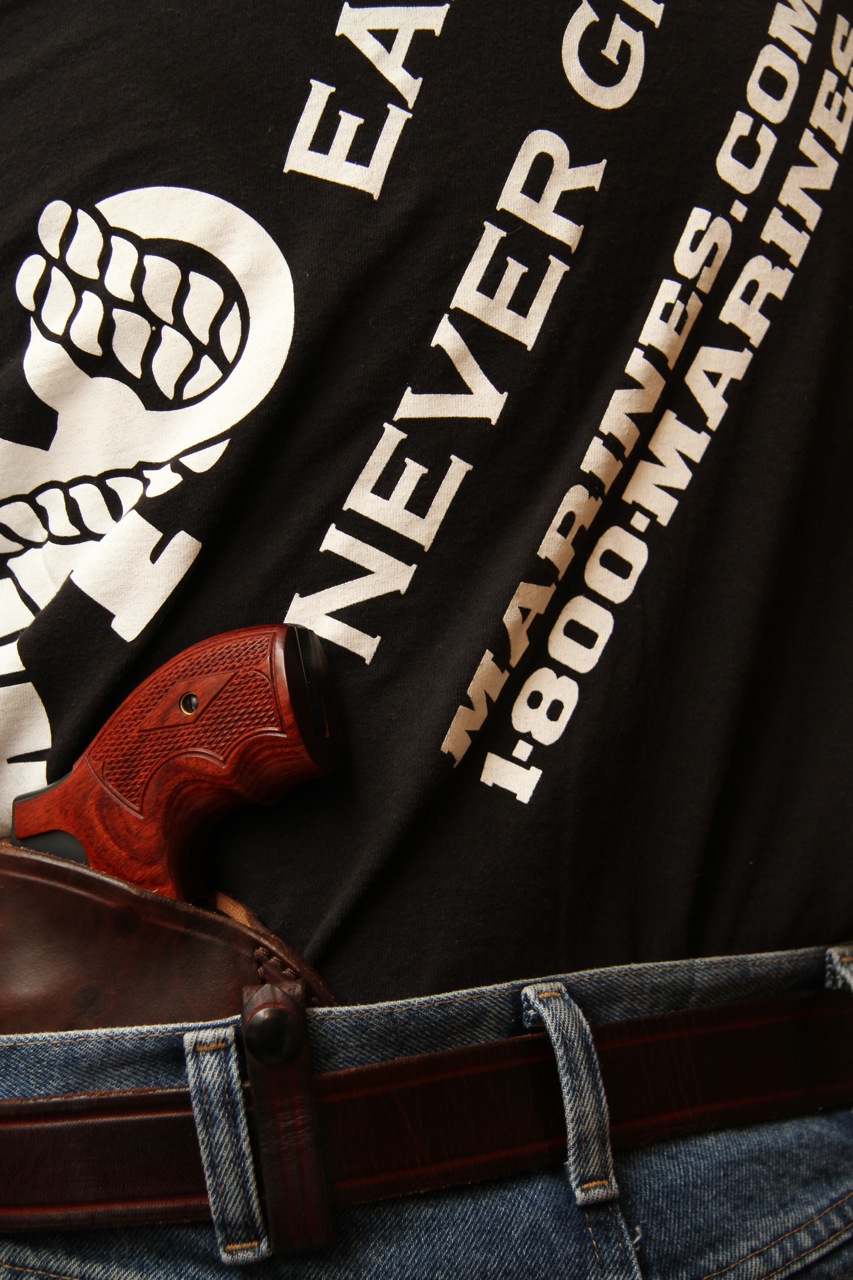 Law enforcement officers and Marines are both trained to handle various scenarios, often involving lethal force in self defense or defense of others. As a matter of fact, many current law enforcement tactics, techniques, and procedures come from the military sector.
Nationwide, law enforcement officers carry their duty weapon everywhere they go. Why? Because handguns are seen as the most effective self-defense tool the officer can keep on their body at all times, and they often find themselves in situations where they have to interact with dangerous people.
Many law enforcement agencies encourage their officers to carry a concealed firearm while off-duty, and I've even heard of agencies requiring their officers to do so. The logic behind off-duty carry is solid – it puts more armed trained personnel on the streets to respond to a given situation.
Much like our brothers in blue, Marines deployed to Iraq and Afghanistan keep their assigned duty weapon with them at all times, regardless of their occupational field. Why? Again, because when going into harm’s way, the firearm is the most effective self-defense tool they can keep within arms reach at all times. Just like America’s law enforcement officers, Marines are often called upon to defend themselves or others from dangerous people.
Unfortunately, when Marines return to the streets of America, their carrying of a firearm turns from an everyday occurrence to a “mother may I” proposition. Not only do they have to navigate the numerous and often changing base regulations governing the personal ownership of firearms, they also have to jump through whatever state legal hoops there may be in order to obtain a permit to carry a concealed firearm. And that's if it's even legal in the state in which they're stationed.
Here in Wisconsin, there is currently no provision to legally carry a concealed firearm (unless, of course, you are a law enforcement officer). My counterpart in Chicago - who holds a highly coveted New York State concealed weapon permit - has to deal with Illinois’ prohibition on concealed firearms as well as Chicago’s now-defunct outright ban on handguns. At least I don’t have to work and live around a city like Chicago whose weekend murder counts requires both hands to count.
I'm just one of many Marines in this state who have qualified numerous times on various military qualification courses, including those required of Marine and Navy military police/security officers. We’ve all received countless hours of training in handling various situations up to and including the appropriate use of deadly force.
In 2004, the Law Enforcement Officers Safety Act was signed into law. This law basically allows active and retired officers to carry a concealed firearm nationwide. The Law Enforcement Alliance of America has the following talking points about the law (in the interest of space, I've cherry picked the pertinent points):
In a time where Homeland Security is paramount, H.R. 218/S.253 gives America countless additional trained and armed first responders at no additional cost to the taxpayers. There’s a long history of armed off duty officers coming to the rescue in life threatening situations H.R. 218 and S. 253 will make that reality even more plausible by expanding the areas where our officers can be equipped for the emergencies they are trained to respond to.
H.R. 218 and S. 253 give off-duty, as well as retired, police officers Right To Carry reciprocity throughout the nation in order to help prevent crime in our communities. All too often, current and retired officers come upon situations in which they can prevent violent crime and save lives. It is common sense they continue to have the tool of their trade available to serve and protect.
H.R. 218 and S. 253 will allow tens of thousands of additionally equipped, trained and certified law enforcement officers to continually serve and protect our communities regardless of jurisdiction or duty status at no cost to taxpayers.
H.R. 218 and S. 253 provide clear, uniform nationwide rules to replace the variety of local laws that create confusion and uncertainty as to whether an officer may or may not carry a firearm when he or she is off duty.
Every single one of those points which LEAA rightfully uses to explain why officers should be able to carry a concealed firearm are applicable to today's active-duty and retired service members. To that list, I would like to add the fact anti-terrorism experts across the country agree military personnel and facilities are high-priority targets for terrorists.
In the end, I think it's about time active-duty and retired service members be extended the same courtesy as active and retired law enforcement officers. This would put countless numbers of armed TRAINED personnel on the streets ready, willing, and able to respond.
Thursday, November 4, 2010
Local range brings frustration

In my last blog, I talked about taking leave (aka vacation), and while it was definitely nice, it was also not without frustration. In this blog, I’d like to talk a little about the source of that frustration – McMiller Sports Center, the only public outdoor shooting range in Southeastern Wisconsin.
First, the good
Aside from the fact that it’s the ONLY public range in SE Wisconsin where you can shoot a rifle, McMiller Sports Center has an assortment of ranges from 25 to 300 yards. For $15, you can shoot all day long on pistol and rifle ranges up to 100 yards; for another $7, you can shoot all day long up to 300 yards. Considering most indoor ranges in the area charge about $15 per hour to shoot pistol calibers only at ranges up to 25 yards, McMiller offers quite a bargain for someone who wants to put some rounds down range.
A Marine’s point of view
Annually, every Marine is required to qualify on the rifle range, and staff non-commissioned officers and officers must additionally qualify on the pistol range. So as a Marine, I’ve been on my fair share of live-fire ranges (known distance, unknown distance, and otherwise), and I have to say I was disappointed with the only public outdoor range in Southeastern Wisconsin.
Is it unfair to compare the way a Marine Corps range is run with the way a public civilian range is run? I don’t think so. Every other public civilian range I’ve been on (and I’ve been on ranges in four different states) somewhat mirrored that of the Marine Corps and were head and shoulders above McMiller in both policies and the staff’s safety awareness.
Infantile policies
Here’s the sad part: if you look solely at the posted policies and procedures, it would appear as though they run a very safe range.
They certainly have overly cautious policies. For instance, they forbid “rapid fire”, which they define as any string of fire faster than one round per second. I guess that’s fine if all you’re doing is confirming your deer rifle is still shooting where it’s supposed to, but it completely rules out any other form of shooting practice including a follow-up shot on a deer. Frankly, it’s ludicrous to think firing two rounds per second (or God forbid three rounds per second) is somehow unsafe. Don’t hamstring those of us who know how to shoot safely just because one person at one time didn’t know what they were doing.
Here’s another of their overly cautious policies. During a cease fire, not only does every uncased weapon have to be unloaded and placed on the bench with the action open, but they also have to have a chamber flag triply showing they’re unloaded and safe. I heard one staff member say their insurance policy requires the chamber flags, which I find hard to believe. If your range safety officers are doing their job and checking every weapon to ensure it’s unloaded AND the weapon’s action is open AND shooters are barred from handling weapons during a cease fire, THEN the chamber flag is nothing more than an annoyance and another way to make a little extra money.
Speaking of RSO’s, the second time I was out there, one of them didn’t like the fact I was bringing four cased firearms to the firing bench. “I only like you to have two guns out at a time,” he says to me. REALLY?! It’s beyond me how either of those two “extra” firearms I wanted to bring out was supposed to jump out of the case, load rounds into a magazine, seat the magazine, chamber a round, remove the safety, and manipulate the trigger in order to discharge a round ALL BY THEMSELF! It’s not like I was trying to fire two firearms at a time, let alone four at a time, but I certainly was trying to save myself the hassle of lugging cased firearms back and forth more than I had to. Oh, and this was his personal policy not the range’s … must be nice to just make stuff up as you go.
Lowest common denominator
Do I hear you saying, “Staff Sgt. Thomas, those sound like perfectly reasonable and safe requirements.”? The problem as I see it isn’t in the details of the policies; the problem is, by instituting such infantile safety measures, the range is doing a disservice to the shooters in removing the shooter’s responsibility to be safe.
Rather than “dumbing” everything down to the “lowest common denominator” (an idea I find disgusting and potentially harmful in its own right), the range should INCREASE their safety standards to make each and every shooter responsible for their own safety at the range. By setting low standards, all you get is low performance; conversely, setting high standards results in high performance. Applied here, that means making every shooter personally responsible for their own safety which allows the RSO’s to supervise rather than bearing the brunt of the safety responsibility.
In this case, those high standards MUST start with the so-called “range safety officers”. While most of the guys who work there as RSO’s are nice enough, all the ones I’ve met are retired from professions which have absolutely NOTHING to do with the safe handling of firearms, and quite frankly, most of them only qualify as RSO’s because of some time they spent in a classroom back who knows how long ago.
Recommendations
The first thing management needs to do is get more RSO’s. I’m afraid one per firing line is just not enough when that firing line has more than a couple people on it. I’d suggest one RSO per a maximum of seven firing positions. That is NOT per seven shooters since a firing line with only seven shooters is likely to have the shooters spread out from one end to the other, and therefore, the RSO would have to divide his attention along the whole firing line rather than concentrating it in a seven-position block.
Management needs to spell out in detail a set of standard operating procedures which will be followed by every RSO on every firing line. They then need to find someone with some experience safely running a range who can train the RSO’s. Then, those RSO’s need to undergo recurrent training on established operating procedures. In the end, every firing line needs to be run in exactly the same safe and orderly manner no matter who’s running it.
Once the RSO’s are trained, I suggest mandating a period of instruction for EVERY shooter who wants to shoot on the range. This period of instruction would cover, among other things, firearms safety rules and range procedures, and this period of instruction would need to be completed every year before the shooter would be allowed to shoot.
I won’t go so far as to say McMiller is completely unsafe. However, I did see some unsafet acts by shooters and a pretty lackadaisical attitude on the part of the RSO’s. Following this simple training plan, the range could really increase the safety of each and every shooter AND provide valuable safety training which those shooters (and RSO’s) can use every time they handle a firearm.
Subscribe to:
Posts (Atom)


 Posts
Posts

